Showing posts with label Kindle Unlimited. Show all posts

Tuesday, October 12, 2021

For self-published authors: What is Kindle Unlimited and should I put my books into it?

Amazon, or the Zon, as some call it, has by far the lion's share of the ebook market. They also have an audiobook platform called Chirp, but I'm not going to talk about that. Today's post is about only about ebooks.

eBooks & eReaders

Amazon calls its ebooks Kindle books, because its ereader is called a Kindle. However, you can read Kindle books using the free Kindle app on almost any PC, Mac, tablet or phone. Basically, Amazon's market consists of anyone who has an Amazon account and some kind of reading device, including iPads and iPhones. 

Apple Books, however, can only be bought via an iOS device, an iPhone, Mac, iPad, etc. There are ways to move them over to Windows but it is not the effortless transaction that most Mac users are looking for.  Kobo and Barnes and Noble both offer a dedicated ereader but also have an app that runs on tablets and other devices. 

So, why does this matter to self-published authors? As an author or publisher, you can upload your books into the self-publishing platforms of Amazon (Kindle Direct Publishing), Barnes & Noble (Nook Press) Google (Google Play Books Partners Center), Apple Books and others, either directly or by using Smashwords or Draft2DIgital. But if you load them only into KDP and opt for the KDP Select designation, your books will be available to borrowers via an Amazon subscription service called Kindle Unlimited. The author is paid based n the pages read, not on the borrow, an important distinction.

Basically, by putting his or her books in Kindle Unlimited (an ironic name in a way, since all KU books are limited only to Kindle), an author promises not to put them in any other ebook store (print versions have no affect in KU status). How can this possibly benefit an author? 

A lot of times, it doesn't. In my experience, whether or not KU is profitable for a book depends on three factors: genre, book length, and ebook price. 

Genre

The only genre I personally have had any success with in Kindle Unlimited is romance, which in my case is actually science fiction romance, Romance readers are voracious. They read so much, it is worth it to them to pay the KU subscription fee. There may be other popular KU genres, but I have not found them. Certainly my YA books never went anywhere in KU. If you have books doing well in a KU, please let me know what genre they are! 


Book Length

Because the author is paid based on pages read, a longer book automatically earns more money than a short one, assuming the reader finishes the book. Of course, if the book is truly short--a novella or a novelette--it probably sells for less, too. But length is something to keep in mind when deciding on KU, yes or no,

Price

If you price your ebook modestly (none of mine are more than $3.99), and the book is long enough, you may well make more money from a KU borrow and full read than from a sale. Of course, price will also have some impact on sale rates, too, so it's all balancing act.

Things to Remember

An important thing to remember is, the Kindle Unlimited signup is for 90-day blocks of time. You can take the book out of KDP Select after 90 days, or you can sign up for another 90 days. I usually launch with the book signed up or KDP Select but pull it out after 90 days if it's not getting enough KU reads to make it worthwhile. 

Also, one benefit to keeping the book in KDP Select status is, you can run a sale or even make the book free for a select number of days per 90-day cycle. The advantage to just changing the price yourself is, the book looks like it's on sale. The regular price appears, but is struck through and the sale price shows as discounted.

You should be aware that Amazon makes no future promises on the per-page rate for KU borrows. It sets aside a chunk of money to pay KU authors/publishers, and then pays out at a rate determined by the number of reads. Right now the rate is approximately $0.004 per Kindle Edition Normalized Page.  My book Alien Bonds is a tad under 130,00 words and that translates to 649 KENP pages. I made about $2.60 on the last full read. At $3.99 retail I make $2.72 in royalties on a sale, which is 12 cents more than the KU borrow. On book 2 of the Wakanreo trilogy, which is shorter, I make less on KU but on book 3, the longest book, I make more from a KU full-read than I do from a sale. 

A non-financial benefit of KU is you can tell when people are actually reading your book because the page count shows on a daily basis. 

And once your pull your book from KDP Select, it is no longer in KU, and then you can load onto every platform available. There is no reason not to! But always, do what's best for your particular book! 


Wednesday, September 29, 2021

A few words on pricing ebooks

If you are planning to self-publish, unless you plan to concentrate on print publishing, you will need to look into your options on pricing ebooks.

In my opinion, ebooks are the reason self-publishing took off as it did. First off, ebooks are relatively easy to create, and second the per copy cost to replicate them, once you have the files in place, is zero. This means that if you are not a well known author, you can price your book very competitively (as low as 99) and thus compete with better known but more expensive writers. The big publishers seem to want ebooks not to sell especially well, at least when they are new, because they price them so high.  Quite often the ebook version is more expensive than the paperback version, defying industry past practice that a higher price meant a more expensive to produce product.

The image above is a the Amazon page for the best seller, Golden Girl, by Erin Hilderbrand,  As you can see the hardcover price is very slightly more expensive than the trade paperback at $17.40 and the Kindle version is priced at  $14.99, less than $2.40 in difference. Well of course, this is a brand new book, But what happens when it has been out for a decade or more? 

Here's the Amazon page for Twilight, a best seller first published in 2006. The hardcover is way more expensive at $22.49 but the Kindle book is more expensive, at $10.99 than the paperback is at $9.43! And by the way, the ebook price is the same on Barnes & Noble and Google Books

Publishers fought with Amazon to be able to control the price of their ebooks. Publishers wanted to be able to protect hardcover sales, which are very profitable. Amazon lost that battle, but you will notice Kindle books usually say "price set by publisher." 

The good news is, if you're self-publishing, you (mostly) control the price! On Amazon, you get the best deal on royalties by pricing your book between $0.99 and $9.99, which is frankly, the range it's best to be in unless you're already a best-selling  author. 

You also control when the price changes, which means you can experiment with different prices.  Be aware that Amazon price matches, so if your book is cheaper in other ebook stores than it is on Kindle, Amazon will drop the price of your Kindle version to match the others' lower price. That is, by the way, the method used to make a Kindle book free on a long-term basis. A book that is in Kindle Unlimited can be free for up to five days every three months, but except by using price matching, you cannot make a Kindle book always free,  It is only because other bookstores allow free ebooks that price-matching can work to make a Kindle book free.


Monday, February 26, 2018

Amazon Exclusivity: What does it buy you?

The answer is, it depends. Mostly, in my experience it depends on your book. If you're self-publishing in the US, your biggest single market will almost certainly be the Kindle store. This is not to say that other markets should be ignored. Barnes & Noble (Nook), Apple  iBooks, Kobo, Google Play, and Smashwords sell plenty of ebooks.

Pricing and Countdown Deals

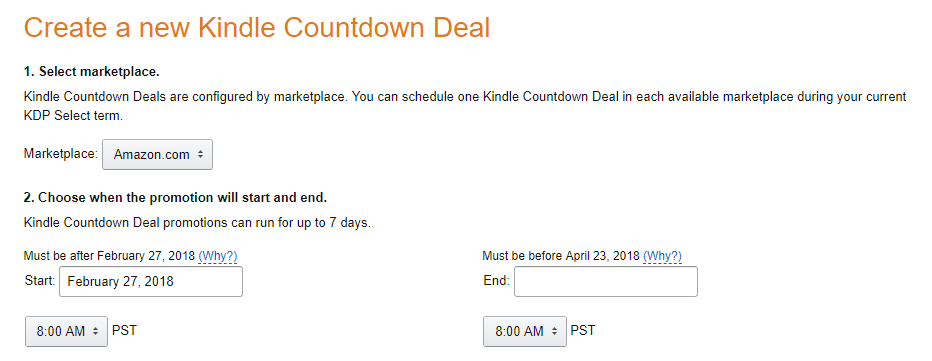
However, selling a book is not always as simple as slapping a price on it and saying "For Sale." Amazon limits the minimum price for a Kindle book sold via KDP to 99¢. It encourages you to price the book between $2.99 and $9.99 by offering the maximum royalty percentage for books in that range. If you enroll your book in the KDP Select program, it means you cannot sell it in ebook form anywhere except the Kindle store (This doesn't apply to print sales). It also means Amazon offers incentives not otherwise available.  Specifically, you can run Kindle Countdown Deals where for the limited number of days specified, the book is available at a sale price (US or UK only). As opposed to you simply lowering the price yourself (which you could do at any time) the regular price still shows up, but it will be crossed out to show the book is on a limited time sale.


Kindle Unlimited (KU)*

The other big benefit is that your book is available in the Kindle Unlimited subscription program. KU subscribers are Amazon customers who pay a monthly flat fee. This allows them to read any book they want in the KU program. There's a limit to how many they can have at once, but not how many they can read. Amazon pays the author not a flat royalty per book, but a per-page-read fee. The amount is not guaranteed, but lately for the US KU market it has been running about 0.0048¢ per "Kindle edition normalized page"**. It is usually less in the foreign KU markets, but the US is usually the biggest one anyway. 


Genre, length, and readability will affect how much money your book can make in the KU program. My experience is limited since I have had only three books in this program. The enrollment is not a marriage; you don't have to keep the book exclusive forever. When you sign up, it's for a 3-month period and then you can renew again every 3 months, if you wish. If you don't renew, your book is no longer in KU and you can't run price promotions. With Saronna's Gift, which is a science fiction romance, I made enough with KU borrows to make it worthwhile to say in for two full periods, that is, 6 months. With Turnabout, a YA science fiction novel that is in no way a romance, I never made much in the KU program so I let it expire after the first 3-month period. Note that Turnabout is also considerably shorter-- only about 80,000 words, which meant less money per KU reader.

To sum up, I would expect a book that was a page turner, a romance, and fairly long would do very well in KU. And, for what it's worth, here's my advice:

  • Always start in KDP Select to see how the book does
  • Set a goal for KU borrows (say a third or maybe half of what the royalties are) and drop out when you go below your goal.
  • Once you're out of KDP Select, go for every market you can! 

Footnotes:
* I am aware that KDP Select also gets your book into the Kindle Owners Lending Library, but frankly, I don't think this is nearly as big a deal as KU so I didn't spend any time talking about it.
** Amazon calculates pages in its own way, but Alien Bonds was 128,000 words and Amazon said it had 658 KENP pages. That's approximately 195 words per KENP page.

Wednesday, July 22, 2015

Saronna's Gift is available on Barnes & Noble!

As of now, Saronna's Gift is no longer exclusively a Kindle ebook.  I loaded an epub version to the Nook Press platform and successfully published it to the Nook store. I had held off on leaving KDP Select for one additional 90-day cycle because the book was doing well with Kindle Unlimited (KU) borrows, but that was tapering off, and so I went ahead and launched it on B&N.

I plan to also load the book to Smashwords soon, so that I can make it available on iBooks and Kobo, and other vendors.  One reason I started with the Nook platform is that the print version is already available on Barnes & Noble, so with Amazon, this will make two retail stores that offer the book in both ebook and hard copy formats.


And there's one nice thing about KDP; Amazon is still reporting on (and thus presumably paying me for) pages of Saronna's Gift read by users who borrowed it while it was in KU. I'll be curious how long it takes for that to stop completely. I expect people borrow books but don't read them right away, so it might be weeks or even a month or two. 


Saturday, July 4, 2015

What Amazon Knows

Digital vs. Print

The experience of digital reading is not fundamentally different from reading on paper, especially if you read on an e-ink device.  But digital purchasing is different.  If you walk into your local bookstore and put cash on the counter for the latest best seller, the retailer has no way to track who you are. With ebooks, the retailer always knows the buyer, because the transaction happens online and involves a credit card.

I don't know much about other ebook readers, because I have had a Kindle since 2007 (that's my latest, the new Kindle Voyage in the photo below), but Amazon has been adding features ever since they came out with the original Kindle. After they created Kindle apps, which works on phones, tablets, PCs, Macs, etc., one of the things they did was to allow you to sync your books across your devices. That is, if you like to read on your phone with a Kindle app while you're on the bus to work, and then switch to reading on your Kindle when you get home, Amazon keeps your place for you. Even audiobook versions are supported by this function, if you buy them from Amazon.


Amazon as Big Brother

Of course, for syncing to work, you have to be connected to Amazon's cloud. When you turn on the wireless connection (or in the new Kindle parlance, you turn off airplane mode), the function of checking for new new items also syncs. As part of that, an enormous database tracks information on every Kindle title you ever bought. Amazon records what devices you sent the books to, where you are in every book or document on every Kindle or app, what text you have highlighted, and any notes you have made. 

Keep in mind that Amazon isn't actually psychic. They don't really know what you have read, only what you have looked at. If you were to open a brand new book and use the Go To menu to go to the last chapter, that would mark that page that as the "last page read." On the Home screen (in List mode), the little dots under the title that track your progress in the book would jump almost to the end, even though you haven't read a word. Likewise, if you finish reading a book and go back to chapter one before connecting, Amazon's database will be marked as if you have just started that book. Of course, a reader usually has no reason to do this, which is why I feel confident in saying Amazon doesn't bother tracking every keystroke.

Further, Amazon only knows the new information after your Kindle has connected. E-ink Kindles have great battery life, but only if wifi and/or 3G are not on, so most people read with in airplane mode. Of course, with tablets and phones, people are used to charging them often, so they're usually connected all the time.  However, even with e-ink Kindles, sooner or later, the reader will need to connect to get a new book, and at that point, the cloud will database will be updated. 

Borrowing ebooks

This need for connectivity means that ebooks can easily support borrowing. Amazon can loan you a book, and then take it back later. In fact, they have two separate borrowing programs. The Kindle Owners Lending Library is an added benefit for people who a) pay the annual Prime membership fee and b) own a Kindle or a Kindle Fire (not just an app on a phone or a tablet). These folks can borrow one book a month, but only books that participate,

The second program is Kindle Unlimited (KU), which is Amazon's ebooks subscription service. KU readers pay a flat fee per month. They can use any Kindle device or app to borrow as many KU-participating books as they like but they can have only 10 out at once. This program is especially popular with romance readers, many of whom go through books like winos go through Two Buck Chuck. In fact, Scribd just pulled most romance titles from their subscription program for being too popular.  They weren't charging enough to be able to pay the authors, and let the readers get all the books they want. I don't understand why they didn't create a second program for romance, or make the first program multi-level, with a higher tier price for voracious readers. Amazon probably has a similar situation, but they took a different approach. 

How the author gets paid for borrowed books

When Amazon started  Kindle Unlimited, they decided that they would pay participating authors a sort of royalty as soon as a borrower got through 10% of the book.  I say "sort of royalty" because the fee was unrelated to cover price or length, and was determined after the fact by dividing up the pot of money Amazon had set aside for that purpose.  These rules meant a novella of 100 pages paid the author the same after the borrower read 10 pages as a 1000-page novel paid after the borrower read 100 pages.  

Guess what? Amazon has changed the rules. They have announced they will pay a per-page fee, based on the actual number of "Kindle Edition Normalized Pages" (KENP).  This shifts the compensation paradigm on its head. Now longer works will make more for the author (still regardless of cover price).  Some people have pointed out that this rewards authors for writing page-turners, which I think is true, and is not a bad thing.

As someone whose only Kindle Unlimited book is a full-length novel, I am fine with the new model. I do wonder what the fee will be. Since the old system paid about $1.40 per borrow, it would have to be at least $0.0028 per page to reward the author of a 500-page book at about the same level as before. There is speculation that it could be higher, and pay out twice as much as before, when the entire book is actually finished. I also wish Amazon would tell us how many copies are being read at once. Right now the report shows only total page count per marketplace (US, UK, Germany, etc), without any indication of how many readers are being counted. 

Conclusion

Amazon knows way more than who is buying which books. They know which books are read immediately, and which wait to be opened; which books are read slowly, and which are devoured on the same day they're purchased; which are abandoned midway through and never finished at all. This is information that print books can never provide.

You can think of Amazon as Big Brother, if you like, but they are far from alone in the corporate world.  We needed a new toilet recently, so I used Google to find photos and info online, so I would know what models the plumber was talking about. I now have toilet ads all over my Facebook feed. Google is pretty much the ultimate Biggest Brother, but they don't seem to be that good at selling ebooks, at least not my ebooks. On the other hand, the commenters on this post seem to have had some luck with Google Play; I wish they had mentioned their genres. If anyone out there has any info on how Google Books is doing generally, I'd love to know.

The writer, as usual, gets left out in terms of information sharing, However, I do like the thrill of checking the new Amazon report and seeing that someone is reading my book!


Thursday, March 26, 2015

Borrow my book— please!

I hate the fact that Amazon requires exclusivity for a KDP book to be in Kindle Unlimited. Exclusivity means the ebook version of a book can only be for sale in the Kindle store. Amazon doesn't care about the print version, but the ebook can only be a Kindle book. Amazon calls this status being in Kindle Select, and they sweeten the deal by allowing a limited number of promotions for Kindle Select books: the author can make the book free or on sale. Of course, you can lower the price of your Kindle book to 99¢ anytime you want to, but that's not the same as displaying it as "Regular price, $3.99, on sale for 99¢, YOU SAVE $3.00!" which is what the Kindle store buyers see with a Kindle promotion. It eevn shows how long the sale will last, which is a good impetus for a browser to click the buy button.

To date, I've never kept a book in Kindle Select for more than a single 90 day cycle. In the past, being able to make the book free for a few days was a great way to get some reviews, and reviews sell books. But once that first 90-day period was over, I always loaded the book on other platforms. I still plan to do that for Saronna's Gift, but not for another 90 days. I've signed on for another cycle because Kindle Unlimited has been pretty good to this book.

As I said in my earlier post, the Kindle Unlimited per-borrow fee paid to the author is running about half of what the royalty is for a #3.99 book. However, that doesn't mean you always make less money with Kindle Unlimited. That's only true if people who would have bought the book borrow it instead. As a new author, I think the borrowers I'm getting are people who might otherwise never have seen or bought my book. Ergo, I'm going to give it another 90 days and we'll see where we are then.

Hopefully, by then that book will have more than 6 reviews. Honestly, people, would it kill you to post a review?  They make it really easy! There's a button right on the product page.


Wednesday, February 25, 2015

The Value of Kindle Unlimited

Well, Saronna's Gift has been out for about six weeks now, and it's been a different experience from the other seven books. This is the first book I have marketed as a romance. Some of the others are very romance-friendly, but in this book, the point of the story is the relationship. It's also the first book I put out since Kindle Unlimited was an option.

In self-publishing ebooks, unknown authors have some tools (besides writing an engaging book) to get their work to readers. Two of the main ones are they can make books free (on some platforms), and they can price them very cheaply. Giving away a book works best as a marketing strategy if it's the first book in a series. But even that has limitations because there are so darn many free ebooks, that many of them are never read. People see “free” and click the button, but once they have the ebook, they don't feel any urge to read it right away. It might not even be a book they would want to read, but what the heck, it was free, right?


The Kindle Unlimited program is different. It's a subscription program, aimed at “heavy” readers, people who read a lot!  They pay a fixed price (I think it's $10 a month) and then they can download as many KU books as they want, but they can only have 10 KU books on their device at a time. Because they have already paid the fee, they feel a need to get their money's worth and read lots of books. They don't download as recklessly as they would totally freee books, but they are willing to take a chance on new (to them) authors.

Amazon pays KU authors for every time a book is borrowed and read to at least 10% of the book. Some authors are not happy because Amazon pays a flat rate, without regard to the book's price or length. Right now, the rate is approximately $1.40. That means if a book sells for 99¢, the author gets paid more for a borrow than a sale. But if the book sells for $3.99, the borrow pays only about half what the sale would pay.  Sounds like a terrible deal, right? I don't happen to think so.

Some people look at a borrow and see it as a lost sale. I don't. I see it as a reader gained. The thing is, if you're Stephen King or J.K. Rowling, anything you write will get a lot of attention. If you're Carmen Webster Buxton, your books have a ton of competition for readers' time and money. A program like Kindle Unlimited gets an unknown author over the barrier of the reader plunking down money to find out if they like a book or not. The free sample feature helps a lot, but I know a lot of people feel like it's not enough to really tell them if they'll like the book. With KU, there really isn't much of a barrier except the reader's time commitment, and they can stop reading any time, return the book, and go on to something else.

And I have to say, when it comes to “heavy” readers, romance readers have it all sewn up! They read more books than almost anyone. Which is fine with me!

Now if they would only write more reviews . . .

Addendum:  Adding a link here to an excellent discussion of this topic on Jane Friedman's blog.