Showing posts with label Kobo. Show all posts

Friday, February 14, 2020

The Ins and Outs of My Recent Fussy Librarian Promotion

First, Happy Valentine's Day! I hope someone gave you a valentine.

Second, if you're not familiar with ebook promotional newsletters, basically, a company creates an email list of ebook buyers (subscribers have to opt in, but it's free to them) and then charges authors and publishers to include their books in a daily email to subscribers. There are many of these services now. BookBub is the biggest name (and the hardest to get into), but there are others, including Book Gorilla, Bargain Booksy/Free Booksy (they separate free books and cheap books into their two emails and if you want both, you have to subscribe to both.), The Fussy Librarian, and Ereader News Today (ENT). When books are on sale but not free, the email entry has an affiliate link and the company gets a small cut from the sale.

On February 8, I ran a Fussy Librarian promotion for The Sixth Discipline (a free ebook!) . The results were pretty good. I had not used FL in a while, so I didn't know what to expect.

I gave away hundreds of copies, mostly on Kindle. And of course, even though the email itself usually generates "sales" for the one day it runs, Amazon's online algorithms push popular books to readers so increased "sales" continues for a few days. As you can see in the screen snap below, the promo offered links to the the book on Kindle, Nook (B&N), Apple, Kobo and Google Play. The results in the list below the screen snap are "sales" for the day of the promo plus three days after.


Vendor:           No. of Copies given away February 8, 9, 10, and 11

Amazon Kindle: 277 (plus 5 paid*), 88 (plus 2 paid*), 28 (plus  1 paid*), 21 (none paid*)
Google Books: 20, 3, 2, 0
iBooks/Apple Books: 19, 0, 0, 0
Barnes & Noble 0, 0, 0, 0
Smashwords: 0, 1, 2, 0 (note: their link was not listed in the ad; these are normal numbers for comparison)
Kobo 0, 0, 0, 0

* The Kindle version wasn't free in all Amazon bookstores so the paid numbers represent foreign sales.

Note that The Sixth Discipline was my first published title, and it came out in 2011. It is free on Amazon only because Smashwords lets an author make a book free, and because Smashwords is a distributor as well as an e-tailer, the book is thus free on other platforms as well. Amazon practices price matching (which is why you see "Tell us about a cheaper price" links on a book's Amazon page);  if you make the book free elsewhere, Amazon will make the Kindle version free also. These days, I usually give away from zero to three Kindle copies every day, so promotions are helpful to boost "sales."

I think in a way, these numbers do a good job of representing how well each vendor is doing at ebook sales. Amazon is way ahead of the pack; its second day number beat all the others' first day totals combined. But Google and Apple both have a significant ebook presence, On the other hand, Barnes & Noble is pretty much dead in the water, and Kobo is going nowhere (at least in the US; it is more popular overseas where Amazon is less dominant). This explains one of the main reasons Amazon can tempt authors and publishers into enrolling their books in Kindle Unlimited: they give up small sales numbers on other platforms in return for money from KU borrows.

Right now both The Sixth Discipline and its sequel No Safe Haven are available only in ebook form but I am having new covers made, and formatting the books for print. I hope to have paperback versions available in a month or so. I might run another promotion after that, as a test of the new covers.

A word to other authors: Giving away this book makes some sense because there is a direct sequel that is not free, and I always see increased sales of it after a promotion of the first book. Giving away a standalone book is not usually as good an idea.  For one thing, a huge number of free ebooks are never read. Making a book free eliminates the cost barrier, so a lot of readers download a free book first, and then look to see if they want to read it. If you have books that are very similar, it can still be a good idea to make a book free for a day or two, in that it can drive up your sales numbers on Amazon temporarily and thus get the book in front of a lot of readers through the "customers also bought" function. That's another benefit of Kindle Unlimited; authors can make their books free or discounted for short periods of time.


Monday, March 12, 2018

How my recent promotion illustrates ebook market share

The Sixth Discipline, the first book of my two-book Haven series is always free, thanks to price-matching. Smashwords lets authors make ebooks available for free, and since that platform can also be used to push the book to iBooks, Nook, and Kobo, as well as smaller vendors (but not Kindle or Google Play), that means self-publishers can make books free on those platforms (and Nook now allows free books to be published on their platform, too). When an ebook is free elsewhere, Amazon will price-match the Kindle version. As you can see by the results below, the Kindle version matters a lot!

The Sixth Discipline was published in 2011, and had its big run in 2013 when I got a BookBub promotion for it and gave away 20,000 copies. Since then, its distrbution numbers (you can't call them sales figures when the book is free) have slowly dwindled. There are a lot of free books, many of them newer, and in a good month, I had been giving away maybe 20-30 Kindle copies, and 10-20 on all other platforms, combined. 


Update:  B&N reporting was very slow and just came in, so I changed the numbers from the original post to reflect those "sales."

The promotion consisted of paying for an entry in The Fussy Librarian daily "free books" email. That email lists links for up to five vendors. The results are in, and for the day of the promotion and the day after, I gave away this many copies:

Kindle =  377
Nook = 8
iBooks = 32
Kobo = 0
Google = 19

A few things jumped out at me. The most obvious is the dominance of the Kindle market. I gave away six times more Kindle copies than all the others combined. The lack of Kobo copies wasn't really surprising since  have never had big numbers on Kobo, but only 8 copies for Nook was telling. I do't think B&N is doing at all well with the Nook.  Also interesting is that Google Books' total was more than double Nook's, while iBooks beat out Google and Nook combined.

And of course, the whole point of paying money to give away a book is that I hope to sell the sequel, No Safe Haven.  Time will tell how that goes.


Monday, February 26, 2018

Amazon Exclusivity: What does it buy you?

The answer is, it depends. Mostly, in my experience it depends on your book. If you're self-publishing in the US, your biggest single market will almost certainly be the Kindle store. This is not to say that other markets should be ignored. Barnes & Noble (Nook), Apple  iBooks, Kobo, Google Play, and Smashwords sell plenty of ebooks.

Pricing and Countdown Deals

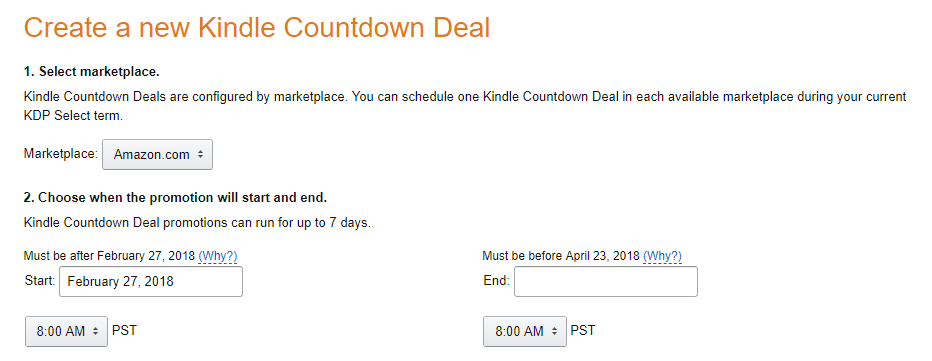
However, selling a book is not always as simple as slapping a price on it and saying "For Sale." Amazon limits the minimum price for a Kindle book sold via KDP to 99¢. It encourages you to price the book between $2.99 and $9.99 by offering the maximum royalty percentage for books in that range. If you enroll your book in the KDP Select program, it means you cannot sell it in ebook form anywhere except the Kindle store (This doesn't apply to print sales). It also means Amazon offers incentives not otherwise available.  Specifically, you can run Kindle Countdown Deals where for the limited number of days specified, the book is available at a sale price (US or UK only). As opposed to you simply lowering the price yourself (which you could do at any time) the regular price still shows up, but it will be crossed out to show the book is on a limited time sale.


Kindle Unlimited (KU)*

The other big benefit is that your book is available in the Kindle Unlimited subscription program. KU subscribers are Amazon customers who pay a monthly flat fee. This allows them to read any book they want in the KU program. There's a limit to how many they can have at once, but not how many they can read. Amazon pays the author not a flat royalty per book, but a per-page-read fee. The amount is not guaranteed, but lately for the US KU market it has been running about 0.0048¢ per "Kindle edition normalized page"**. It is usually less in the foreign KU markets, but the US is usually the biggest one anyway. 


Genre, length, and readability will affect how much money your book can make in the KU program. My experience is limited since I have had only three books in this program. The enrollment is not a marriage; you don't have to keep the book exclusive forever. When you sign up, it's for a 3-month period and then you can renew again every 3 months, if you wish. If you don't renew, your book is no longer in KU and you can't run price promotions. With Saronna's Gift, which is a science fiction romance, I made enough with KU borrows to make it worthwhile to say in for two full periods, that is, 6 months. With Turnabout, a YA science fiction novel that is in no way a romance, I never made much in the KU program so I let it expire after the first 3-month period. Note that Turnabout is also considerably shorter-- only about 80,000 words, which meant less money per KU reader.

To sum up, I would expect a book that was a page turner, a romance, and fairly long would do very well in KU. And, for what it's worth, here's my advice:

  • Always start in KDP Select to see how the book does
  • Set a goal for KU borrows (say a third or maybe half of what the royalties are) and drop out when you go below your goal.
  • Once you're out of KDP Select, go for every market you can! 

Footnotes:
* I am aware that KDP Select also gets your book into the Kindle Owners Lending Library, but frankly, I don't think this is nearly as big a deal as KU so I didn't spend any time talking about it.
** Amazon calculates pages in its own way, but Alien Bonds was 128,000 words and Amazon said it had 658 KENP pages. That's approximately 195 words per KENP page.

Thursday, September 7, 2017

Turnabout is now in other ebook stores!

I always launch new ebooks in KDP Select, which means they're only available on Amazon, but eventually, I let that enrollment expire and launch in other stores.  That has happened with my newest novel Turnabout, now available as follows:

Buy links

US Kindle store (also available in every other Kindle store)
iBooks
B&N Nook
And as a paperback: AmazonBarnes & Noble

Updated: Finally got Google Books to accept my file; or rather, their tech staff did. I have to say both B&N and Google Books could make their interface easier to use.

From the first Amazon review:
"This is a fascinating story, looking at a lot of society’s issues from a different view point, but still exploring them in a very interesting way. Buxton creates some wonderful characters to tell this story. Marjani and Esi are two that stand out amongst a cast of exceptionally well written characters that don’t just tell this story, but through their portrayals give us a true understanding of what it is like to live in this alternate universe.
Buxton has also done an interesting job of creating Makoro, building this alternate universe and timeline, and how it has evolved under such different circumstances."
And, as a bonus, I dropped the ebook price to $2.99, at least for now.


Tuesday, December 6, 2016

Google is now making web cards for books!

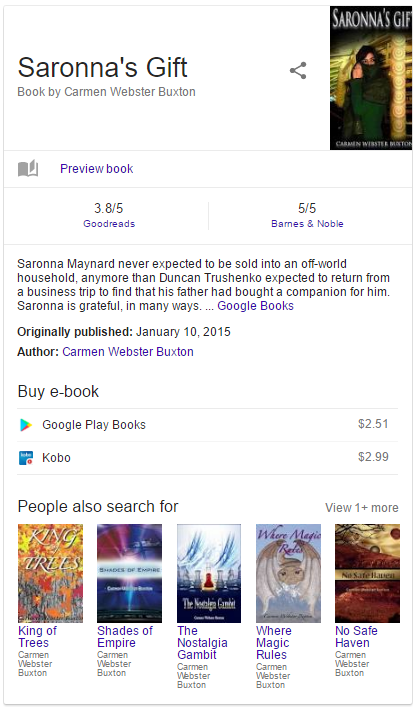
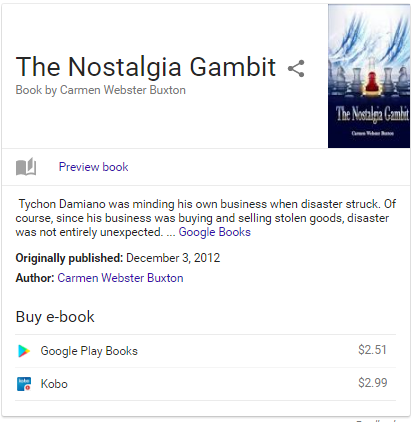
A recent post on The Digital Reader blog (also on Facebook, if you prefer to follow it that way), describes how Google is creating "knowledge panels" (I always just called them web cards, although I suppose they are a special kind of web card) for books when you search on the book title.

See below for examples from two of my books, the first being one with both print and ebook formats and the second for an ebook-only title.


Naturally enough, the "Preview book" link takes you to Google Books. This is true whether there is a print version or not. There is no mention that I can find of Smashwords, Amzon/Kindle or any vendors other than Google, Barnes & Noble, and Kobo, except that the GoodReads site is owned by Amazon and always includes their links.  


The only title I don't have on Google Books is Where Magic Rules, and its web card doesn't get a preview link at all. Maybe I need to load that one onto Google Books, too?

Saturday, May 31, 2014

Self-publishing in print: Biting the technology bullet

From Wikimedia Commons: by Daniel Maclise_-Caxton Showing the First Specimen of His Printing to King Edward IV at the Almonry, Westminster


I recently (as in yesterday!) retired from a legal and regulatory publishing company where I worked in systems support. I also recently attended Balticon, where I attended panels on self-publishing.

The thing about self-publishing is, the author is the "publisher" but not generally the distributor. He or she decides on the content of the book, but rarely does he sell it directly to readers. For self-publishing in ebook form, there are many places on the web that an author can go to to upload their book for sale to the public. Amazon, Barnes & Noble, Kobo, Smashwords, and iBooks all have platforms that allow an author (or someone with rights to publish) to create an account, upload a file, and start selling ebooks. I have used Amazon KDP, B&N Nook Press, and Smashwords, and they were all pretty easy. Smashwords also pushes the book out to the other other retailers, as most of their authors sell more books on those platforms than on Smashwords itself. I have heard good things about Kobo Writing Life but I have never used it because my Kobo sales are so small it hardly seems worth it. My understanding is that Apple is the most difficult to deal with because for one thing, it requires you to download their ebook producer app, which runs only on a Mac. I am also ignorant of Google Books, which seems to be a thing unto itself. Even Smashwords cannot publish to Google Books.

On all platforms, what the author has to provide to publish an ebook successfully is usually a file with the text of the book (the formats accepted vary) and a file for the cover, plus assorted bits of information collectively known as metadata (data about the book), such as author, title, ISBN (in some cases), and genre/tags.

If you're willing to accept the platform's standard conversion, some platforms allow you to upload your book in MS Word, but the problem with that is, the conversion is not great at maintaining the style and features you want. The standard format for ebooks is ePub, which, like Mobi (the format on which Kindle books are based) is simply a set of HTML tags that are used in an agreed-upon standard way. Even KDP will accept ePub, although Amazon does not like advertising that fact. I have been relying on a conversion house to produce the files I needed; the ebooks look great-- nice style for scene breaks, consistent chapter title pages, and working table of contents-- but they are not that cheap and they can only be edited by going into the HTML, which is tedious.

To self publish in print and sell on the web easily, (Lighting Source and Amazon CreateSpace are the two most popular venues), what an author/publisher needs is a PDF of a file laid out in pages, with headers (and possibly footers) and all the standard info a book needs about copyright and such. Strictly speaking, you can do this layout in MS Word, but that is not only incredibly painful, it's also very time-consuming, as Word tends to decide what it wants to do in some circumstances, and wresting control from it takes knowledge and the kind of patience of a Dalai Lama.

Having decided to take the publishing plunge and move into print (now that I have more time), I just ordered a copy of Adobe InDesign, the premier desktop publishing application, which will produce well formed pages, and also ePub files. The advantage to doing this is that I pay for it once, and then I can also use it will all my books. Adobe also offers a cloud-based monthly subscription service, but they had something of a security scandal with that, so I don't want to go that route.

Assuming I can learn to use the software, I am hoping it will provide a solution to the problem of corrections. Once I put a book into InDesign, I will proof from paper copy, make corrections, and then make the software spit out the ePub file. I realize I might have to do a few tweaks in ePub, but it should still be better than my current workflow. And this way, I get two birds with one stone; you can never have too many dead birds!

Sunday, September 30, 2012

The Sixth Discipline is free on Kobo!

I didn't think Kobo price-matched for books that are free, but apparently they do because The Sixth Discipline is now FREE on Kobo!  I updated the Free eBook page (see tab above right) to include it. That means the book is now free almost everywhere!

Kindle (US only)
iBooks
Nook (Barnes & Noble)
Diesel
Smashwords
Kobo
Blio

The only exception is the Sony ebookstore, which seems to take forever to change anything (and they still don't have my fifth book Shades of Empire, either!).


Saturday, June 30, 2012

No news is not good news

I just checked Sony, Kobo, and Blio ebookstores, and The Sixth Discipline is still not free on any of them. I can find plenty of free Smashwords book in the Sony store, so I think they are just slow to make the change. The Kobo store doesn't seem to have any Smashwords books below 99¢, so I think they simply don't support price matching to $0.00. Blio doesn't have a good way to search or sort for free Smashwords books, and they are very new, so I have no clue what their policy is.

I guess time will tell.


Wednesday, May 25, 2011

A whole crop of new eReaders!

Barnes & Noble just announced a new touch-screen e-ink Nook ereader with a Pearl screen for only $139. In an amazing coincidence, that's the same price as a wi-fi-only Kindle, unless you get the cheaper one with ads.  Ooops! I mean the one with special offers. -)

The new Nook looks pretty cool! And now they are claiming superior battery life over the Kindle. No mention of how it competes with Sony Reader Touch, who now has the dubious distinction of being almost $100 more expensive than the new Nook for what looks like the same features.

And then there's the Kobo touch screen  which Border will sell in the US for $129. It's like ereaders are coming out of the woodwork.

Personally, I'm not that enamored of touch screens in an ereader.  One of things I like about the Kindle is the one-handed reading, which, with the cat in my lap (see his photo in the right-hand column) is all I can manage.  I can hold the Kindle in my right hand and press the Next Page button with my thumb with no problem. That works while standing on the subway, too. I have used my husband's iPad to read, and while the color screen is fabulous for short term reading, I get tired of needing two hands to read.

But the best thing about new ereaders is it shows companies like Amazon, Barnes & Noble and Kobo are invested in digital reading.  Remember it's not printing that makes a book; it's the story that counts. And ereaders mean that reading is now more convenient, which will (hopefully) mean that people do it more often.