Sunday, February 13, 2022

ALIEN BONDS is free in the Kindle store for a few days!

The first book in my Wakanreo trilogy ALIEN BONDS, is free in the US and UK Kindle stores from today through this Thursday, February 17!

The story:
A story of two very different people from two very different cultures, a sort of AVATAR combined with PRIDE & PREJUDICE. In ALIEN BONDS, two lives are changed in an instant. Industrial chemist Dina Bellaire travels all the way to the planet Wakanreo to advance her career. Her carefully planned life goes up in flames the second she meets Kuaron Du, a Wakanrean who makes his living singing ancient songs in a dead language. Both of them know they can’t go back to the way they were before they met. They just have to convince the rest of the universe that what happened to them is real.

Kirkus Reviews: "Buxton offers an SF story about interplanetary love triumphing, despite the odds.. . . readers will feel truly immersed in their religion, values, and technology of Wakanreo and appreciate the relevance of Buxton's depiction of a couple fighting for their relationship in a climate of intolerance in this thought-provoking work. A dense but often engrossing tale, grounded in a relatable love affair."

Monday, January 24, 2022

Snippet from SHADES OF EMPIRE

Shades of Empire, a dark space opera/romance, is set in the far future and incorporates three separate love stories. It begins in the harem of Emperor Lothar du Plessis, absolute ruler of a planet known as Gaulle. In Chapter Two the action switches to the merchant starship Queen Bee, owned and captained by Madeline Palestrino.  This book is free in Kindle Unlimited.

From Chapter Two: 

     Her first mate had a stoic expression when she told him she was leading the expedition herself. “Be careful, Maddy.”      
     She grinned, knowing that he wanted to go. “Aren’t I always?” 
     He snorted as he checked the fastening of her helmet clamps. “Sure, sure. Just like the time we went after the Emperor Lothar.” 
     She frowned at this mention of past adventures. “Take care of my ship, Niels,” she said as she stepped into the shuttle. 
     “I will.” He swung the bay door shut. 
     Madeline heard a thunk as the lock engaged. The four other members of the expedition, fully suited, waited for her on the shuttle. Madeline took a seat at the back and let the safety harness envelop her. A shuttle ride always made her feel claustrophobic. The confined space, defined by a center aisle with five seats on either side, seemed too small for the passengers, even now with only half the seats occupied.
     Also, the loss of the ship’s artificial gravity when the door locked invariably disconcerted her. Her magnetic boots held her feet to the deck, but the deck no longer felt like the floor when her arms floated at her sides. The trip took only a few minutes. She heard the soft whir of the docking port engaging and the abrupt whoosh as their harnesses retracted. 
     “Face plates closed,” Madeline said. Madeline waited until she heard four distinct clicks, and then pressed her own helmet control to close her face plate. She locked it with her chin control, and then stood up. 
     Magnetic boots clanged on the steel deck as the five of them started walking. The iris of the shuttle’s docking port opened smoothly, but instead of the inside of an airlock, Madeline saw the pitted surface of a docking hatch. “What the hell?” she said under her breath. She had been last in line, but now she pushed her way forward. “What’s wrong? Why didn’t the pod hatch open?” Her voice sounded breathy on the com, as if she were out of shape. 

     Mahler had been in the lead. He stepped back now and used one gloved finger to trace a thick metallic ridge, just visible where the lip of the docking port met the skin of the life pod. “Look at that, skipper!” 
     For a moment Madeline stared at the ridge without comprehension. It looked almost like scar tissue. Finally, she understood. “It’s welded shut!” 
     Mahler nodded. “It sure is.” 
     Clinking noises sounded behind her. Madeline realized her crew members were talking to each other by touching helmets to carry the sound, so that she couldn’t hear them. “Coms on full,” she ordered at once. “If you’ve got something to say, let’s hear it.” 
     After a brief silence her senior tech spoke up. “Why would anyone seal up a life pod like this, skipper? Unless there was something dangerous—” He didn’t finish the sentence, but three helmeted heads nodded in agreement. 
     Madeline frowned. 
     Before she could speak, Mahler pointed again. “Hey, isn’t that—” He stopped, and they all stared at the swirl of gold lines at the top of the hatch cover. 
     Madeline reached out her hand and traced the gold ridges that looped and whirled back upon themselves. “The Emperor’s personal seal.” She couldn’t feel any texture through her glove, except that the seal was solid, not holographic. 
     There was another silence. The crewman at the back of the line tried to shuffle his feet, and swayed back and forth as the magnets held his feet down. Lineaus was new to the crew of the Bee. He needed practice at this kind of exercise. 
     “So,” Madeline said, “Emperor Lothar doesn’t want us to open this life pod. Seems to me that that’s a damn good reason to cut it open right now.” 
     Someone sighed, and Madeline grinned. “No sense being stupid about it, though. Buchanan!” 
     Her senior tech started. “Yes, ma’am?” 
     Madeline patted the dull black surface of the hatch cover. “See if you can find out more about what’s behind this door before we cut it open.” 
     The line of men seemed to relax all at once. Madeline resisted the temptation to check the charge on the laser pistol attached to the leg of her suit. No sense making them more nervous. 
     Buchanan stepped up to the hatch and opened his tech kit. After a few minutes with a portable scanner pressed against the hatch, he shook his head inside his helmet. “I think there’s someone there. I get a life sign reading, but there’s no sound to speak of.” 
     “Just one person?” 
     He nodded, and then his eyes opened wide. “Wait!” 
     “What?” Madeline demanded. “What is it?” 
     “Voices! I hear voices. Someone screaming—a woman I think. And someone crying. No, wait, now it’s a man talking. Damn, I can’t hear well enough!” 
     Madeline made up her mind. “Okay, that’s enough. If Emperor Lothar has someone shut up in there, we need to get him—or her—out.” She stepped back as her crew moved to obey her. 
     There was no further suggestion that the life pod was too dangerous to breach. Instead, Mahler and Buchanan operated the cutting tool that was part of the shuttle’s emergency equipment, while Doc checked his medkit, and Lineaus watched the thin crack on one side of the hatch grow steadily longer. 
     Finally, the tool moved back to the top of the long irregular oval, almost completing the cut. 
     Madeline stepped forward and punched the center of the oval. The piece of titanium alloy clattered noisily in the thin air of the shuttle as it bounced off the airlock walls. Beyond the opening, Madeline saw only darkness. 
     She stepped up to the ragged hole and shone her helmet lamps into the life pod’s airlock. Empty. The lamps made cones of light that cut through the blackness, but they illuminated nothing but an uncluttered airlock. 
     Mahler peered around her. “Looks damn near new.” 
     Madeline agreed. She climbed through the threshold they had made and took a few tentative steps. “Wait there,” she said, when she saw the controls for the interior hatch. “Let me check this out.” This hatch looked perfectly normal. The dials appeared to be working. 
     “Check your helmets,” Madeline called out. “There’s not a whole lot of air in here.” She heard clinking noises as they all checked each others’ helmet clamps one more time. Madeline engaged the control for the hatch and whirled the pointer to the unlocked position. She took a deep breath and pulled open the hatch. 
     Darkness. Nothing but more darkness. Madeline leaned into the opening and let her helmet lamps flicker over either side of the corridor. The pod had been gutted, but not in any sort of emergency. The suspended animation bays were gone, but all the power leads and other connections had been neatly stubbed off. Whoever had refitted this pod had had time to do a thorough job. 
     “See anything, skipper?” Buchanan’s voice sounded in her ear. “Anyone there?” 
     “Nothing much yet.” She took a few steps, her magnetic boots clanging on the metal deck every time she put her foot down. The empty bays made for a spooky atmosphere. Madeline checked each one, half expecting someone to jump out at her. No one did. 
     Where had the voices come from then? The only sounds she heard were her own metallic footfalls reverberating noisily. “There’s enough air to carry sound, anyway. No gravity, though. It looks okay so far. Come on and we’ll check it out.” 
     More clanging echoed as the crewmen all climbed through the jagged opening and walked through the airlock to join her in the pod. They advanced cautiously, Buchanan first. 
     Before he even reached Madeline, he stopped at the life support controls. “Hey, skipper, look at this.”
     Madeline stepped over to the console. “What is it?” 
     “There’s plenty of oh two aboard.” The senior tech sounded indignant. “Someone’s set the air feed to little more than a slow leak.” 
     Madeline lifted her brows. It seemed an odd thing to do. No one could live on that amount of oxygen, and what good was a slow leak over no air at all? “Really? Can you get us more air, then?” 
     He nodded and muttered something. His hands moved over the controls and in a few seconds a loud hiss told Madeline he had been successful. 
     It occurred to her that the sound wouldn’t have carried without air. “So what’s our status now?” she asked. “Do we still need our helmets?” 
     Behind the transparent polymer, Buchanan’s face twitched as he considered the question. “Give it a few more minutes. Let’s see what we find.” 
     Madeline nodded, and turned back to her exploration. Everyone had waited for her. She resumed the lead, and was only a few steps ahead when the corridor suddenly opened into the pod’s small bridge. A dark shape filled the space in the middle of the empty room where the navigation controls should have been. 
     Madeline advanced a few more steps and bent her head down so that her helmet lamps shone full on the shape. It was an acceleration couch, fitted out with some sort of life support system that swaddled its half-reclined occupant in nutrient gel. 
     “Is he alive?” Doc’s voice, breathy on the com, almost squeaked with tension. 
     The other crewmen seemed just as interested. The four of them crowded into the room, but clustered together into a tight clump near the entrance to the corridor. 
     The life pod’s only passenger was obviously male. Except for the life support mask that covered most of his face, he was as naked as the day he had been born, and just as helpless. Every limb and his head, too, had been immobilized by restraints. 
     Madeline walked slowly around him so that she could see him better. His eyes were closed, but his chest rose and fell with regularity. The life support mask obscured the lines of his face, but through the transparent cover, Madeline could see that he looked exhausted. Deep shadows ringed his eyes, and the color had drained from his face. His skin was light enough that the mottled green and yellow bruises on his chest looked startling. A long, half-healed scrape ran up one side of his torso. 
     “Why would anyone leave someone like this?” she wondered out loud. 
     Doc stepped forward and bent over the stranger. “He looks drugged or something.” He glanced over his shoulder at Buchanan. “Can I open my helmet?” 
     The senior tech checked a control on his wrist and nodded. “Should be okay now.” 
     Doc unlocked his face plate and it flipped backwards over his head. 
     Madeline followed suit. She sniffed. The air in the pod felt dead, no matter what Buchanan said. It wasn’t so much the faint metallic odor, but rather the cold, dampness of it against her skin that repelled her. 
     None of the other three had followed Doc’s example. They all stood and watched from behind their face plates as their friend bent over the imprisoned stranger. Just as Doc reached out a hand to touch the man, an abrupt click made the Bee’s medic jump in surprise. 
     A motorized arm slid smoothly along on a track, then stopped after a few centimeters. It held a hypospray directly over the imprisoned man’s head. Another click sounded and the hypo moved downward, pressed against the man’s neck, and discharged with a faint hiss. 
     Just as the stranger groaned and opened his eyes, the cabin lights came on, illuminating the scene abruptly. The man stared at the crew of the Bee, blinking as if their presence confused him. He didn’t look at them for long, however. After a few seconds, his eyes moved to stare directly at the space in front of Madeline.

Shades of Empire is available on Kindle and is free in Kindle Unlimited.

Wednesday, January 12, 2022

When the plot requires a good person to do a bad thing

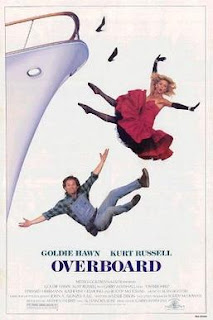
A really old movie that I had not seen in decades was on TV over the weekend, so I watched it. Overboard , starring Goldie Hawn and Kurt Russell, came out in 1987, and in one way it's fascinating. The premise is that a blue-collar guy-- a carpenter, who happens to be a widower with four sons-- tricks a beautiful, wealthy woman suffering from amnesia into thinking she is his wife. 

He doesn't do this for sex, but to get free labor. As his wife, the amnesia victim believes she has no choice but to clean his house, cook his meals, and take care of his kids.  He refrains from physical intimacy, however, telling her she always sleeps on the couch because the bed hurts her back. 

The thing is, taking advantage of her in this way would be a  truly despicable act except for the way the situation was set up: she is the despicable person. In addition to being an incredible snob, she hired the carpenter to do a job and then not only refused to pay him, she destroyed his tools, his means of support. In a way, she could be said to have earned his revenge, especially because he doesn't trick her into having sex. Over time, we realize she's such a terrible person because she was raised to think of herself as being better than ordinary people who have to work for a living. The more she's away from her native environment, the more she changes into a normal caring person. Spoilers: Of course, as the movie is a romcom, in the end they fall in love. 

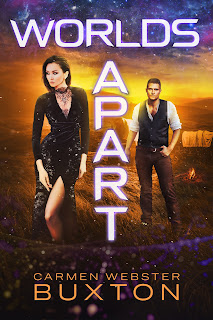
My science fiction romance Worlds Apart uses a similar plot device but with the genders reversed. As the title suggests, the story is about a couple who are from different planets. The plot needs the two people to end up on the same world for a good amount of time.  Rishi, the female main character, is very wealthy and lives on Subidar, a world with an advanced level of technology, while Prax, the male main character was born and raised on Celadon, a recently discovered colony world where technology is not as advanced, especially among Prax's people, who are Greek-speaking nomadic herders. 

 Rishi had grown up as the youngest member of a large and loving family, but  her entire family was wiped out in a planet-wide disaster, leaving her the heir to both great wealth and great sorrow.   When she sees Prax's clan under attack by a band of outlaws who are much better armed, she saves them by ordering her ship to attack the outlaw leader; this is a violation on a non-interference directive so she does this at some risk to herself.

The clan is understandably grateful.  They hold a celebratory feast  during which Rishi consumers several glasses of the local wine, which is more potent for some people than for others. When the clan leader asks Rishi to name her reward, she asks for Prax.  Feeling bound by duty to pay the debt his people owe, Prax agrees to leave his world and his family and everything that is familiar and go with her. 

The next morning, Rishi wakes up cold sober and is appalled at her own behavior in asking for a person as a reward. She feels remorse for taking him away from his family. But when Rishi asks Prax if he wants to go home, he says no, feeling that his clan owes her a debt and he has been chosen to pay it. His sense of duty is stronger than his loneliness and fear of the unknown.

Like the hero in Overboard, Rishi cannot bring herself to cross the line of extorting sex from someone, so she declines Prax's tentative overtures. Thus, they arrive back at Subidar, two people who are strongly attracted to each other, but with a big complication: Prax doesn't realize that Rishi feels morally bound not to take advantage of his offer so he thinks she's simply not interested. And Rishi cannot bring herself to urge Prax to go home. 

Spoilers: they work things out! 

Friday, December 17, 2021

My books in the Smashwords sale


 My books that are not in Kindle Unlimited are for sale (and at the moment are either free or half price)  at Smashwords. Unlike the Kindle store or many ebookstores, Smashwords is in no way linked to a specific ereader or app. You can buy books in epub (used for Nook, Apple iOS, Kobo and most other ereaders), mobi (used by Kindles), or PDF (to read in a web browser)
You should check out Smashwords! A lot of other authors' books are for sale, too!  


Tuesday, December 7, 2021

A Snippet from THE SIXTH DISICPLINE

The Sixth Discipline is free in most eBook stores. The story. a far future, slow burn romance is set on the isolated colony world of Haven, where the human colonists inhabit three different environments: cities surrounded by small towns and farms, a vast forest inhabited by mystics, and mountain valleys from whence fierce hunters and warriors raid the other two groups. 

Here's a snippet from Chapter Six, when things start to get really interesting.

Francesca stopped turning and pointed to a distant, snow-capped peak in the middle of the range. “That looks like Mount Fujiyama. We must be on Hayden land, which means we’re a good ways south of the city.”

South of the city might mean closer to the Sansoussy Forest. Ran-Del cleared a space in the dirt with his foot and handed her a twig. “Show me.”

Francesca squatted down and drew a small circle. “That’s Shangri-La.” Below the city, she sketched a large four-sided shape, narrow at the top and wide at the bottom, and drew a zigzag line across the middle of it. “This is the Hayden estate, and the wiggly line is the mountains behind us.” She added a dot near one end of the line of mountains. “This mark is where Fujiama is.”

“Where on your map is the forest of the Sansoussy?” Ran-Del asked, crouching down beside her.

She drew a large, amorphous, cloud-like shape just slightly south and a good ways west of the city.

“There,” she said. “I’m not really sure where your people live, but that’s the Sansoussy Forest. It’s prairie and rolling hills up until then.”

Ran-Del studied the marks and then looked up at the sun. “We’re north of your mountain, so we must be about here.” He laid a small pebble in the top half of the squarish shape.

“I think so,” Francesca said. “But Hayden land extends quite a ways. I can’t say for sure.”

“That answers where,” Ran-Del said, sitting back on his heels. “But why would your father have put us here?”

“I’m not positive.” She ducked her head, and Ran-Del sensed embarrassment. “But I have an idea. It’s related to the reason Pop snatched you from the forest in the first place.”

He focused his psy sense for any hint that she was lying. “What is the reason?”

Francesca seemed reluctant to answer directly. “Did Pop tell you about what’s happening to Great Houses like Hayden?”

Ran-Del recalled Baron Hayden’s monologues and nodded. “He said his house was in danger of being swallowed up by a bigger house. He said that I could help him to stop it in some way, but he would never say how.”

Francesca stared straight ahead as if she found the distant mountains fascinating. “Well, the reason we’re vulnerable is because right now the House of Hayden is just me and Pop; there’s no one else. Pop was an only child, and so was I. I have no Hayden cousins, no siblings, and no husband.” She paused and then blurted out, “Pop wants you to change that.”

Ran-Del frowned, still not understanding. “What do you mean? How could I change that?”

Francesca frowned, plainly annoyed at having to explain everything in explicit language. “Pop wants me to get married—to you.”

Ran-Del suspected her first of lying, and then of mocking him. His psy sense told him neither was the case. “Your father is insane. You had nehiver seen me until three days ago, and I had never seen you.”

“He may have a crazy idea in his head, but he’s quite sane.”

Ran-Del got to his feet and looked down at her. “He has day bats nesting in his upper branches. He came into our forest and shot me with a dart, as if he had been hunting his dinner. Are you telling me that he was looking for a husband for you?”

“Yes.” Francesca shaded her eyes from the morning sun as she looked up at him.

Ran-Del snorted with rampant disbelief and looked away to scan the countryside. “No one would do that,” he said, looking back at her. “He cares about you. Why would he find a stranger—a wild man your people called me—to marry his only daughter?”

Francesca still crouched on the ground. She sighed and hugged her knees. “This wasn’t a sudden aberration, this respect for your people. Pop has always thought you lived a cleaner life.” She frowned as if she thought her meaning wasn’t clear. “Not cleaner in the sense of hygiene, but more honest—more honorable. When he realized that he’d need to arrange a marriage for me, he got this idea that the thing to do was to find a Sansoussy to marry me.”

A Sansoussy?” Ran-Del said. “Just any Sansoussy?”

“Not exactly.” Francesca stood up but turned her eyes away as if she were reluctant to meet his gaze directly. “Pop didn’t want anyone too old or too young—or already married. And he wanted a warrior who had some psy sense, because that combination gave me the most protection.”

“So he went into the forest to acquire a Sansoussy?” The more Ran-Del thought about it, the more it fit Stefan Hayden’s words and actions. His anger rose when he realized how thoroughly the Baron had planned to hijack his life. “And I was the first one whose caste bracelet had the right beads, is that it?”

“Pretty much.”

Ran-Del crossed his arms over his chest. “What made him think I’d marry you? He could have kept me locked in his house forever, but he couldn’t have made me marry you.”

Francesca’s face turned a deep red, and she radiated mortification. “I was supposed to seduce you. Pop said you’d feel obligated to marry me if I did.”

Ran-Del had to clench his jaw for a second, to control his anger. If it got any worse, he would need the First Discipline. “You knew what your father wanted, and you agreed to it?”

Her face contorted in agitation. “No! I mean, yes, I knew, but I never agreed to it. The day before yesterday I told him flat out that I wouldn’t do anything to try to make you marry me. Then last night Pop offered me a glass of wine, and after that it’s all a blank.”


Buy links for most ebookstores here:  http://carmenspage.blogspot.com/p/free-ebook.html

Wednesday, November 17, 2021

Killing off characters is a balancing act

Something that came up in my writer's group once  was the question all fiction writers face: when and if should you kill off a character.  Death is a part of life.  And really, if there is no risk in a situation, there is not much tension either.  Unless you're writing a romance where the two (or more than two, in some subgenres) main characters need a happy-ever-after (or at least a happy for now) ending, any character should be fair game to get killed off, right?
Maybe not.  When you write a story, you're asking the reader to invest their time and a certain level of emotional involvement in that story, and that means making them care what happens to the characters.  Killing a character for a good reason is one thing, but killing them off just to show that you're willing to do it can leave your reader feeling betrayed, almost like they've invested time in a relationship and then found out it could never have worked out. I had a friend who is also a fan tell me that when she came to the part of THE SIXTH DISCIPLINE where a major character dies, she closed her Kindle and put it down like it was on fire.
So what constitutes a good reason to axe a character?  I heard a writer at the Pikes Peak Writer's Conference (and I wish I could remember her name!) articulate the best rule I have ever heard:  you kill off a character to change the motivation of another character.  That works for me.  But I would also say that, if possible, it should not be as simple as their death making the protagonist mad for revenge or anything like that.  Certainly you don't want a female character to get horribly slaughtered just to motivate the male hero to a blood rage (a.k.a., "Women in refrigerators syndrome"). I always thought killing off the First Lady in the movie Independence Day was really just a milder variant of shoving her body into a refrigerator. She wasn't seen as necessary to the story (she didn't fly a jet or otherwise act heroically) and her death, conveniently staged in her husband's presence, motivated him even further to kill those nasty aliens. When I killed off the character that my friend complained about, I answered that he or she was in the way of the plot.
The revenge angle is not totally bad, but I think it works better when one character's sudden, abrupt absence actually changes the other character's circumstances.  Maybe now they have to support themselves, or rule their country, or face their fears, or go on a quest, or even just finally grow up.
Of course, in spec fic, an added complication is that magic/advanced technology may make it possible to bring the dead back to life, and I don't mean as zombies or anything like that.  I mean that spec fic writers have to be careful they don't make death meaningless.  That happened on STAR TREK TOS a little bit and TNG even more so.  The damn transporter got too powerful!  If a machine can basically copy a person's molecules and later spew out a copy on demand, no character ever needed to stay dead. 
So, have you ever read a book and gotten really angry at the author for killing a character?  Or have you seen an instances of too-powerful-transporter syndrome?  Alternatively, have you ever ready a story and thought (as was said at my writer's group once), "Really, the author should have just killed off x?"

Thursday, November 4, 2021

Travel to Wakanreo for only 99¢!

NOTE: the sale is over! 

 From today through November 10th, ALIEN BONDS, the first book in my Wakanreo trilogy (usually priced at $3.99) is on sale for 99¢. Grab it now!


 Alien Bonds is undeniably a love story. It concerns two people, a human woman and a Wakanrean man, who meet at the beginning of the story on his world, called Wakanreo, and instantly mate from a  biological reaction that occurs only in Wakanreans. But even though Dina goes home with Kuaron that night, she does not love him.. You cannot love someone you don't know. It is over the next several months that her love for him grows, as does his for her. But at the same time, the story explores the culture and history of Wakanreo. It's an attempt to show what a world would be like if looks didn't matter—if people had no choice in who they paired off with. and thus sex had nothing to do with morality.  How would this uncontrollable mating affect the societies that formed on this unique world? In human history, much of the stratification of society was achieved by people only marrying within their own social order. What if it wasn't possible to enforce that kind of discrimination? 

Read the book to find out! Alien Bonds  is available in paperback and on the Kindle, and it's free in Kindle Unlimited. 


Tuesday, October 12, 2021

For self-published authors: What is Kindle Unlimited and should I put my books into it?

Amazon, or the Zon, as some call it, has by far the lion's share of the ebook market. They also have an audiobook platform called Chirp, but I'm not going to talk about that. Today's post is about only about ebooks.

eBooks & eReaders

Amazon calls its ebooks Kindle books, because its ereader is called a Kindle. However, you can read Kindle books using the free Kindle app on almost any PC, Mac, tablet or phone. Basically, Amazon's market consists of anyone who has an Amazon account and some kind of reading device, including iPads and iPhones. 

Apple Books, however, can only be bought via an iOS device, an iPhone, Mac, iPad, etc. There are ways to move them over to Windows but it is not the effortless transaction that most Mac users are looking for.  Kobo and Barnes and Noble both offer a dedicated ereader but also have an app that runs on tablets and other devices. 

So, why does this matter to self-published authors? As an author or publisher, you can upload your books into the self-publishing platforms of Amazon (Kindle Direct Publishing), Barnes & Noble (Nook Press) Google (Google Play Books Partners Center), Apple Books and others, either directly or by using Smashwords or Draft2DIgital. But if you load them only into KDP and opt for the KDP Select designation, your books will be available to borrowers via an Amazon subscription service called Kindle Unlimited. The author is paid based n the pages read, not on the borrow, an important distinction.

Basically, by putting his or her books in Kindle Unlimited (an ironic name in a way, since all KU books are limited only to Kindle), an author promises not to put them in any other ebook store (print versions have no affect in KU status). How can this possibly benefit an author? 

A lot of times, it doesn't. In my experience, whether or not KU is profitable for a book depends on three factors: genre, book length, and ebook price. 

Genre

The only genre I personally have had any success with in Kindle Unlimited is romance, which in my case is actually science fiction romance, Romance readers are voracious. They read so much, it is worth it to them to pay the KU subscription fee. There may be other popular KU genres, but I have not found them. Certainly my YA books never went anywhere in KU. If you have books doing well in a KU, please let me know what genre they are! 


Book Length

Because the author is paid based on pages read, a longer book automatically earns more money than a short one, assuming the reader finishes the book. Of course, if the book is truly short--a novella or a novelette--it probably sells for less, too. But length is something to keep in mind when deciding on KU, yes or no,

Price

If you price your ebook modestly (none of mine are more than $3.99), and the book is long enough, you may well make more money from a KU borrow and full read than from a sale. Of course, price will also have some impact on sale rates, too, so it's all balancing act.

Things to Remember

An important thing to remember is, the Kindle Unlimited signup is for 90-day blocks of time. You can take the book out of KDP Select after 90 days, or you can sign up for another 90 days. I usually launch with the book signed up or KDP Select but pull it out after 90 days if it's not getting enough KU reads to make it worthwhile. 

Also, one benefit to keeping the book in KDP Select status is, you can run a sale or even make the book free for a select number of days per 90-day cycle. The advantage to just changing the price yourself is, the book looks like it's on sale. The regular price appears, but is struck through and the sale price shows as discounted.

You should be aware that Amazon makes no future promises on the per-page rate for KU borrows. It sets aside a chunk of money to pay KU authors/publishers, and then pays out at a rate determined by the number of reads. Right now the rate is approximately $0.004 per Kindle Edition Normalized Page.  My book Alien Bonds is a tad under 130,00 words and that translates to 649 KENP pages. I made about $2.60 on the last full read. At $3.99 retail I make $2.72 in royalties on a sale, which is 12 cents more than the KU borrow. On book 2 of the Wakanreo trilogy, which is shorter, I make less on KU but on book 3, the longest book, I make more from a KU full-read than I do from a sale. 

A non-financial benefit of KU is you can tell when people are actually reading your book because the page count shows on a daily basis. 

And once your pull your book from KDP Select, it is no longer in KU, and then you can load onto every platform available. There is no reason not to! But always, do what's best for your particular book! 


Wednesday, September 29, 2021

A few words on pricing ebooks

If you are planning to self-publish, unless you plan to concentrate on print publishing, you will need to look into your options on pricing ebooks.

In my opinion, ebooks are the reason self-publishing took off as it did. First off, ebooks are relatively easy to create, and second the per copy cost to replicate them, once you have the files in place, is zero. This means that if you are not a well known author, you can price your book very competitively (as low as 99) and thus compete with better known but more expensive writers. The big publishers seem to want ebooks not to sell especially well, at least when they are new, because they price them so high.  Quite often the ebook version is more expensive than the paperback version, defying industry past practice that a higher price meant a more expensive to produce product.

The image above is a the Amazon page for the best seller, Golden Girl, by Erin Hilderbrand,  As you can see the hardcover price is very slightly more expensive than the trade paperback at $17.40 and the Kindle version is priced at  $14.99, less than $2.40 in difference. Well of course, this is a brand new book, But what happens when it has been out for a decade or more? 

Here's the Amazon page for Twilight, a best seller first published in 2006. The hardcover is way more expensive at $22.49 but the Kindle book is more expensive, at $10.99 than the paperback is at $9.43! And by the way, the ebook price is the same on Barnes & Noble and Google Books

Publishers fought with Amazon to be able to control the price of their ebooks. Publishers wanted to be able to protect hardcover sales, which are very profitable. Amazon lost that battle, but you will notice Kindle books usually say "price set by publisher." 

The good news is, if you're self-publishing, you (mostly) control the price! On Amazon, you get the best deal on royalties by pricing your book between $0.99 and $9.99, which is frankly, the range it's best to be in unless you're already a best-selling  author. 

You also control when the price changes, which means you can experiment with different prices.  Be aware that Amazon price matches, so if your book is cheaper in other ebook stores than it is on Kindle, Amazon will drop the price of your Kindle version to match the others' lower price. That is, by the way, the method used to make a Kindle book free on a long-term basis. A book that is in Kindle Unlimited can be free for up to five days every three months, but except by using price matching, you cannot make a Kindle book always free,  It is only because other bookstores allow free ebooks that price-matching can work to make a Kindle book free.


Sunday, September 12, 2021

Re-launch of ALIEN BONDS!

 Based on reviewer feedback, and to achieve a more uniform series look, I have relaunched Alien Bonds with a new cover! Only the Kindle version has the new cover, so far. I have to do some tweaks to republish the paperback.  But here it it is!