Showing posts with label borrowing ebooks. Show all posts

Monday, February 26, 2018

Amazon Exclusivity: What does it buy you?

The answer is, it depends. Mostly, in my experience it depends on your book. If you're self-publishing in the US, your biggest single market will almost certainly be the Kindle store. This is not to say that other markets should be ignored. Barnes & Noble (Nook), Apple  iBooks, Kobo, Google Play, and Smashwords sell plenty of ebooks.

Pricing and Countdown Deals

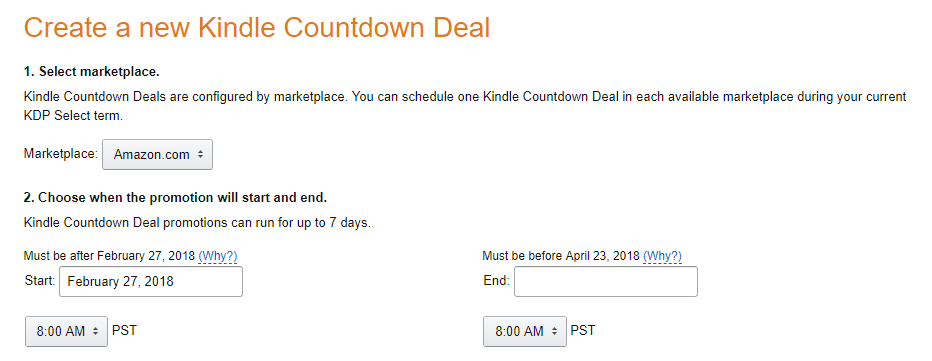
However, selling a book is not always as simple as slapping a price on it and saying "For Sale." Amazon limits the minimum price for a Kindle book sold via KDP to 99¢. It encourages you to price the book between $2.99 and $9.99 by offering the maximum royalty percentage for books in that range. If you enroll your book in the KDP Select program, it means you cannot sell it in ebook form anywhere except the Kindle store (This doesn't apply to print sales). It also means Amazon offers incentives not otherwise available.  Specifically, you can run Kindle Countdown Deals where for the limited number of days specified, the book is available at a sale price (US or UK only). As opposed to you simply lowering the price yourself (which you could do at any time) the regular price still shows up, but it will be crossed out to show the book is on a limited time sale.


Kindle Unlimited (KU)*

The other big benefit is that your book is available in the Kindle Unlimited subscription program. KU subscribers are Amazon customers who pay a monthly flat fee. This allows them to read any book they want in the KU program. There's a limit to how many they can have at once, but not how many they can read. Amazon pays the author not a flat royalty per book, but a per-page-read fee. The amount is not guaranteed, but lately for the US KU market it has been running about 0.0048¢ per "Kindle edition normalized page"**. It is usually less in the foreign KU markets, but the US is usually the biggest one anyway. 


Genre, length, and readability will affect how much money your book can make in the KU program. My experience is limited since I have had only three books in this program. The enrollment is not a marriage; you don't have to keep the book exclusive forever. When you sign up, it's for a 3-month period and then you can renew again every 3 months, if you wish. If you don't renew, your book is no longer in KU and you can't run price promotions. With Saronna's Gift, which is a science fiction romance, I made enough with KU borrows to make it worthwhile to say in for two full periods, that is, 6 months. With Turnabout, a YA science fiction novel that is in no way a romance, I never made much in the KU program so I let it expire after the first 3-month period. Note that Turnabout is also considerably shorter-- only about 80,000 words, which meant less money per KU reader.

To sum up, I would expect a book that was a page turner, a romance, and fairly long would do very well in KU. And, for what it's worth, here's my advice:

  • Always start in KDP Select to see how the book does
  • Set a goal for KU borrows (say a third or maybe half of what the royalties are) and drop out when you go below your goal.
  • Once you're out of KDP Select, go for every market you can! 

Footnotes:
* I am aware that KDP Select also gets your book into the Kindle Owners Lending Library, but frankly, I don't think this is nearly as big a deal as KU so I didn't spend any time talking about it.
** Amazon calculates pages in its own way, but Alien Bonds was 128,000 words and Amazon said it had 658 KENP pages. That's approximately 195 words per KENP page.

Saturday, July 4, 2015

What Amazon Knows

Digital vs. Print

The experience of digital reading is not fundamentally different from reading on paper, especially if you read on an e-ink device.  But digital purchasing is different.  If you walk into your local bookstore and put cash on the counter for the latest best seller, the retailer has no way to track who you are. With ebooks, the retailer always knows the buyer, because the transaction happens online and involves a credit card.

I don't know much about other ebook readers, because I have had a Kindle since 2007 (that's my latest, the new Kindle Voyage in the photo below), but Amazon has been adding features ever since they came out with the original Kindle. After they created Kindle apps, which works on phones, tablets, PCs, Macs, etc., one of the things they did was to allow you to sync your books across your devices. That is, if you like to read on your phone with a Kindle app while you're on the bus to work, and then switch to reading on your Kindle when you get home, Amazon keeps your place for you. Even audiobook versions are supported by this function, if you buy them from Amazon.


Amazon as Big Brother

Of course, for syncing to work, you have to be connected to Amazon's cloud. When you turn on the wireless connection (or in the new Kindle parlance, you turn off airplane mode), the function of checking for new new items also syncs. As part of that, an enormous database tracks information on every Kindle title you ever bought. Amazon records what devices you sent the books to, where you are in every book or document on every Kindle or app, what text you have highlighted, and any notes you have made. 

Keep in mind that Amazon isn't actually psychic. They don't really know what you have read, only what you have looked at. If you were to open a brand new book and use the Go To menu to go to the last chapter, that would mark that page that as the "last page read." On the Home screen (in List mode), the little dots under the title that track your progress in the book would jump almost to the end, even though you haven't read a word. Likewise, if you finish reading a book and go back to chapter one before connecting, Amazon's database will be marked as if you have just started that book. Of course, a reader usually has no reason to do this, which is why I feel confident in saying Amazon doesn't bother tracking every keystroke.

Further, Amazon only knows the new information after your Kindle has connected. E-ink Kindles have great battery life, but only if wifi and/or 3G are not on, so most people read with in airplane mode. Of course, with tablets and phones, people are used to charging them often, so they're usually connected all the time.  However, even with e-ink Kindles, sooner or later, the reader will need to connect to get a new book, and at that point, the cloud will database will be updated. 

Borrowing ebooks

This need for connectivity means that ebooks can easily support borrowing. Amazon can loan you a book, and then take it back later. In fact, they have two separate borrowing programs. The Kindle Owners Lending Library is an added benefit for people who a) pay the annual Prime membership fee and b) own a Kindle or a Kindle Fire (not just an app on a phone or a tablet). These folks can borrow one book a month, but only books that participate,

The second program is Kindle Unlimited (KU), which is Amazon's ebooks subscription service. KU readers pay a flat fee per month. They can use any Kindle device or app to borrow as many KU-participating books as they like but they can have only 10 out at once. This program is especially popular with romance readers, many of whom go through books like winos go through Two Buck Chuck. In fact, Scribd just pulled most romance titles from their subscription program for being too popular.  They weren't charging enough to be able to pay the authors, and let the readers get all the books they want. I don't understand why they didn't create a second program for romance, or make the first program multi-level, with a higher tier price for voracious readers. Amazon probably has a similar situation, but they took a different approach. 

How the author gets paid for borrowed books

When Amazon started  Kindle Unlimited, they decided that they would pay participating authors a sort of royalty as soon as a borrower got through 10% of the book.  I say "sort of royalty" because the fee was unrelated to cover price or length, and was determined after the fact by dividing up the pot of money Amazon had set aside for that purpose.  These rules meant a novella of 100 pages paid the author the same after the borrower read 10 pages as a 1000-page novel paid after the borrower read 100 pages.  

Guess what? Amazon has changed the rules. They have announced they will pay a per-page fee, based on the actual number of "Kindle Edition Normalized Pages" (KENP).  This shifts the compensation paradigm on its head. Now longer works will make more for the author (still regardless of cover price).  Some people have pointed out that this rewards authors for writing page-turners, which I think is true, and is not a bad thing.

As someone whose only Kindle Unlimited book is a full-length novel, I am fine with the new model. I do wonder what the fee will be. Since the old system paid about $1.40 per borrow, it would have to be at least $0.0028 per page to reward the author of a 500-page book at about the same level as before. There is speculation that it could be higher, and pay out twice as much as before, when the entire book is actually finished. I also wish Amazon would tell us how many copies are being read at once. Right now the report shows only total page count per marketplace (US, UK, Germany, etc), without any indication of how many readers are being counted. 

Conclusion

Amazon knows way more than who is buying which books. They know which books are read immediately, and which wait to be opened; which books are read slowly, and which are devoured on the same day they're purchased; which are abandoned midway through and never finished at all. This is information that print books can never provide.

You can think of Amazon as Big Brother, if you like, but they are far from alone in the corporate world.  We needed a new toilet recently, so I used Google to find photos and info online, so I would know what models the plumber was talking about. I now have toilet ads all over my Facebook feed. Google is pretty much the ultimate Biggest Brother, but they don't seem to be that good at selling ebooks, at least not my ebooks. On the other hand, the commenters on this post seem to have had some luck with Google Play; I wish they had mentioned their genres. If anyone out there has any info on how Google Books is doing generally, I'd love to know.

The writer, as usual, gets left out in terms of information sharing, However, I do like the thrill of checking the new Amazon report and seeing that someone is reading my book!


Friday, May 10, 2013

Last day to borrow King of Trees

Today (May 10) is the last day that King of Trees will be in the KDP Select Program, which means it's also the last day it will be in the Kindle Owners Lending Library (KOLL). In additon to books published via KDP Select, there are a lot of tradionally published books in the KOLL, too.  Amazon negotiated with some publishers and pays a fee every time somone borrows a book. The Harry Potter books are the most famous example.

If you own a Kindle or a Kindle Fire and you have Amazon Prime, you can borrow one book a month for free from the KOLL.  The trick is, you have to borrow the book from your Kindle or Kindle Fire.  You can't do it fom the web.

But, since King of Trees is no longer going to be in KDP Select, that means I can load it to other vendor platforms, which I plan to do ASAP. I'll be sure to post when it hits the major ebookstores.

Friday, June 22, 2012

Borrowing books from the Kindle Owners Lending Library

Amazon has some interesting benefits for Amazon Prime members.  Amazon Prime is a membership program that costs $79 a year. The most-often used benefit is that you get free 2-day shipping on physical items you order from Amazon—print books, DVDs, whatever—so long as it's sent to you by Amazon and not a retail partner.   There are also movies and TV shows you can watch online for free, and there is the Kindle Owners Lending Library (KLL or KOLL).

The KOLL is more limited because it can only be used by Prime members who also own Kindles (either e-ink Kindles or a Kindle Fire). I think one reason a lot of Kindle owners don't know about KOLL is that not that many of them have Prime; when your books are digital, you don't care about 2-day shipping. Also, borrowing books is one of the few functions that can't be done from the web; you must initiate borrowing from the Kindle itself.

If you are browsing or searching the Kindle store and you see a prime symbol  like the one above, that tells you that the book can be borrowed for free by Kindle-owning Prime members. To borrow the book, you will have to find it in the Kindle store from the Kindle itself.

To browse the KOLL (assuming you qualify)  do the following steps:
  1. Turn on the wireless on your Kindle
  2. Go to the Kindle storefront
  3. Select the Browse — All Categories option
  4. That brings up a pick-list; select the last item, Kindle Lending Library
  5. Once you are in the Kindle Lending Library, you can browse by genre and then sort by what's new or what's popular; be prepared for a huge amount of porn if you don't pick a specific genre
  6. You can also search as usual using the search bar and specifying an author or title.
Once you find the book you want, if it's in the KOLL there should be a Borrow for Free option next to the Buy button. Select that, and the book will then be downloaded to your Kindle.  The limitations are that you can only borrow one book per month and you can only borrow books that are permitted to be in the KOLL by the publishers; however, you can take as long as you need the read the book. All the Happy Potter books are included, as well as any book that participates in the Kindle Select program.  Also, Amazon will keep any notes and highlighting, so if you buy a book after borrowing it, you won't lose your notes.

Of my books, only Shades of Empire and Where Magic Rules are in the KOLL. If you're eligible, check them out (literally!).  Did I mention Amazon pays the author a fee every time the book is borrowed?

Note:  As of March, 2013, only my latest book King of Trees is in the KOLL. I don't leave books in the KDP Select program forever because to do that, I would have to not sell them anywhere else.